Toward a Mathematical Framework for Psychedelic Visual Phenomena:
Exploring Connections Between Graph Theory and DMT Research

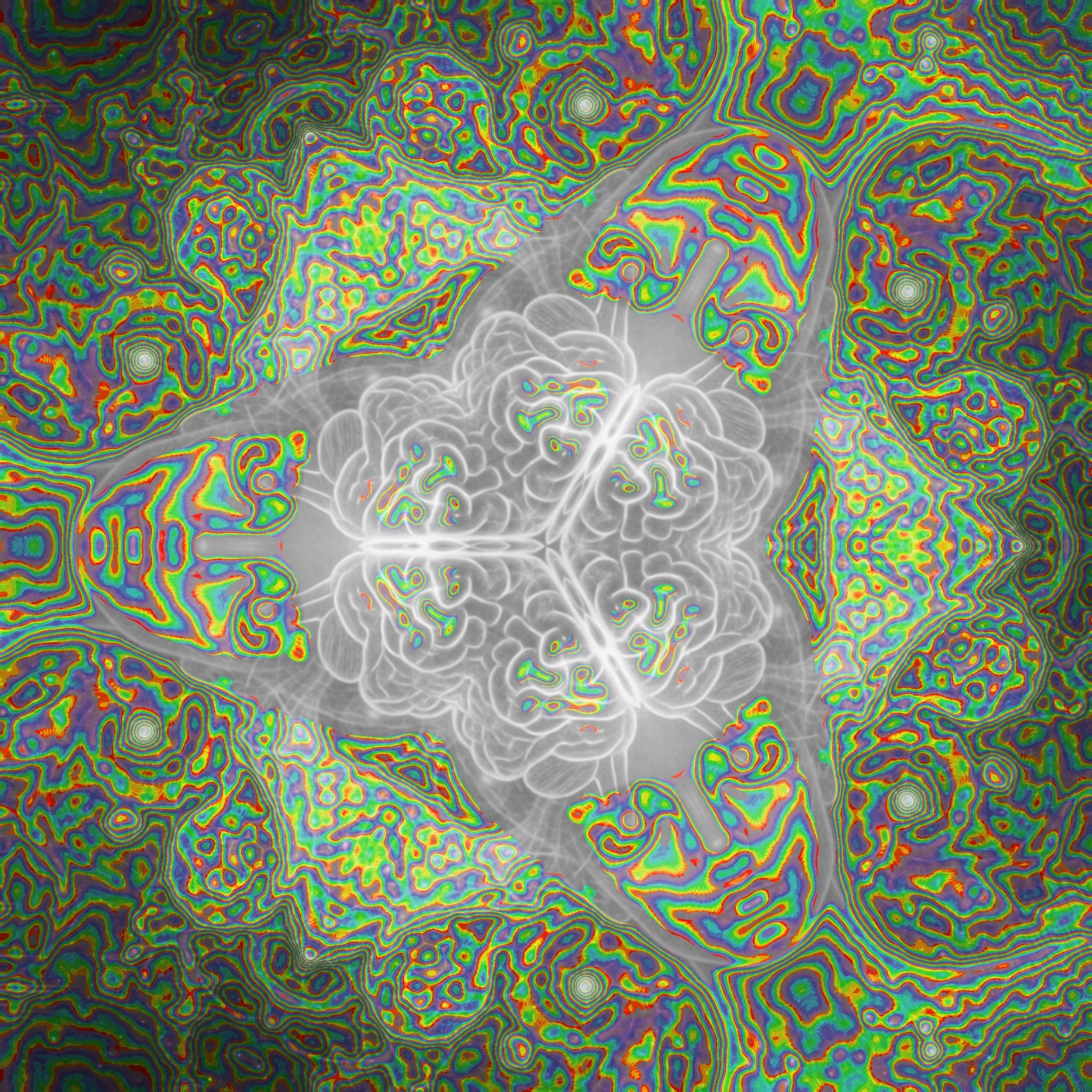
(Here's a fun little thing I was noodling with this past December. There was some super exciting developments in the field lately so I decided to make an update to my draft and finally share it!
If you haven't read the 4 Color Theorem piece yet, I highly recommend it before diving into this, although this is short it refers to alot of material.
I’m no scientist, but this is my little contribution to the thing we have all been observing and trying to track… inspired by people like Andres Gomez Emilson, Donald Hoffman, and Ralph Abraham.
I'll be sharing a more personal reflection on the art and math of these inquires to compliment this piece. Enjoy! )
✨️🪷✨️
Toward a Mathematical Framework for Psychedelic Visual Phenomena:
Exploring Connections Between Graph Theory and DMT Research
Abstract
This paper explores potential connections between mathematical topology, specifically graph theory concepts like the Four Color Theorem, and documented patterns in psychedelic visual experiences. Drawing on verifiable research from established institutions, we examine whether mathematical constraints might provide insights into the consistency of visual phenomena reported in DMT studies. This represents a novel theoretical exploration rather than established scientific fact.
Keywords: Four Color Theorem, DMT, form constants, visual patterns, graph theory, psychedelic research
1. Introduction
Contemporary psychedelic research has documented consistent visual patterns across subjects and substances, while mathematical topology has established fundamental constraints governing spatial relationships. This paper explores whether these domains might be connected, acknowledging that such connections remain speculative and require empirical validation.
2. Documented Research on DMT and Psychedelic Visual Phenomena
2.1 Johns Hopkins Research
Johns Hopkins obtained regulatory approval in the United States to reinitiate research with psychedelics in healthy, psychedelic-naive volunteers in 2000, with Dr. Roland Griffiths as Founding Director. The Center for Psychedelic and Consciousness Research was backed by $55 million in funding, making it what's believed to be the first such research center in the U.S., and the largest research center of its kind in the world.
A 2020 study by Davis et al. examined "Survey of entity encounter experiences occasioned by inhaled N,N-dimethyltryptamine (DMT): Phenomenology, interpretation, and enduring effects", documenting consistent phenomenological reports across subjects.
2.2 Imperial College London Research
Imperial's Psychedelic Research Group was the first in the world to investigate the brain effects of LSD using modern brain imaging and the first to study psilocybin – the active compound in magic mushrooms – for treating severe depression. The Centre for Psychedelic Research focuses on the action and clinical use of psychedelics; exploring consciousness and treatments for mental health disorders.
Dr. Robin Carhart-Harris stated: "DMT is a remarkable tool that can enable us to study and thus better understand the psychology and biology of dying". Research found that "DMT mimics near-death experience in the brain".
2.3 DMTx Extended-State Research
DMTx is "developed by Dr. Andrew Gallimore and colleagues" and "uses target-controlled infusion to hold volunteers in a stable DMT state for unprecedented lengths of time". The technique was "proposed by neurobiologist Andrew Gallimore and psychologist Rick Strassman, based on the latter's legendary DMT research".
Imperial College London completed "the first team to successfully complete a DMTx study in 2021, led by PhD student Lisa Luan" under "Dr. Chris Timmermann, who heads the DMT Research Group".
Additionally, in recent work this past early June, "Traces of the Other – Are DMT Entities Real? DMT Phenomenology in the Framework of Conscious Realism", is a scientific preprint authored by neuroscientist Dr. Andrew Gallimore, Niff Hermansson, and cognitive scientist Professor Donald Hoffman.
In this theoretical paper, the authors explore whether the reported encounters with intelligent, apparently autonomous entities during high-dose DMT experiences are purely internally-generated hallucinations, or whether they could represent genuine interactions with conscious agents that exist beyond our normal perception.
The paper synthesizes Dr. Hoffman’s "Conscious Realism" (which suggests that spacetime and objects are simply a "user interface" evolved for survival, much like icons on a computer screen) with Dr. Gallimore’s work on mapping the mathematical architecture of the psychedelic experience. By introducing the concept of "traces," the authors propose that certain structured, geometric features of the DMT state could act as observable interactions with information-bearing conscious systems outside our typical perceptual range.
This partnership is a joint venture between Noonautics and the Trace Institute (founded by cognitive scientist Dr. Donald Hoffman).
5-HT2A Receptor Mechanisms
Recent research has identified crucial mechanisms underlying psychedelic effects:
Research published in Science found that "activation of intracellular serotonin 2A receptors is responsible for the plasticity-promoting and antidepressant-like properties of psychedelic compounds". The study showed that "serotonergic psychedelics are highly lipophilic compounds that can easily pass through cell membranes, and some of them (DMT and psilocin) target intracellular 5-HT2A receptors to induce neuronal growth".
Research published in Nature Communications demonstrated that "a threshold level of 5-HT2A-Gq efficacy and not β-arrestin recruitment is associated with psychedelic potential".
4. Klüver Form Constants and Mathematical Patterns
4.1 Historical Foundation
Heinrich Klüver systematically studied the effects of mescaline in 1926 and "noticed that mescaline produced recurring geometric patterns in different users. He called these patterns 'form constants' and categorized four types: lattices (including honeycombs, checkerboards, and triangles), cobwebs, tunnels, and spirals".
Klüver "classified the patterns into four distinct types that he dubbed 'form constants': lattices (including checkerboards, honeycombs and triangles), tunnels, spirals and cobwebs".
4.2 Mathematical Analysis
Mathematical investigation by researchers found that "form constants, when viewed in V1 coordinates, essentially correspond to combinations of plane waves, the wavelengths of which are integral multiples of the width of a human Hubel-Wiesel hypercolumn".
Jack Cowan and Bard Ermentrout reported in 1979 "that the electrical activity of neurons in the first layer of the visual cortex could be directly translated into the geometric shapes people typically see when under the influence of psychedelics".
5. The Four Color Theorem
5.1 Mathematical Foundation
The Four Color Theorem states that "for a loopless planar graph... the vertices of every planar graph can be colored with at most four colors so that no two adjacent vertices receive the same color". The theorem "states that any map in a plane can be colored using four-colors in such a way that regions sharing a common boundary (other than a single point) do not share the same color".
The theorem was proven "by Appel and Haken in 1976" and later "improved upon in 1997 by Robertson, Sanders, Seymour, and Thomas".
6. Theoretical Exploration: Potential Connections
6.1 Pattern Constraints
The consistency of Klüver's four form constants across different subjects and psychedelic substances suggests underlying constraints in neural processing, similar to how the Four Color Theorem establishes constraints for planar graph coloring. Both systems demonstrate that complex visual or spatial relationships can be characterized by a minimal set of elements.
6.2 Topological Considerations
The visual cortex maintains spatial organization that could potentially be modeled using graph-theoretic approaches. When psychedelic compounds destabilize normal processing through 5-HT2A receptor activation, the resulting patterns may reflect fundamental constraints in how the visual cortex can organize information.
7. Limitations and Speculative Nature
This analysis represents theoretical speculation rather than established scientific fact. The connections proposed between mathematical topology and psychedelic phenomenology require:
Empirical validation through systematic study
Development of quantitative methods for measuring visual patterns
Mathematical modeling that bridges abstract topology and neuroscience
Rigorous testing of proposed relationships
8. Conclusion
While documented research reveals consistent patterns in psychedelic visual experiences and mathematical topology provides frameworks for understanding constraints in spatial systems, the connections explored here remain speculative. Future research combining quantitative analysis of psychedelic experiences with mathematical modeling may reveal whether such connections have empirical validity.
The consistency of form constants across subjects and substances, combined with the universal applicability of topological constraints like the Four Color Theorem, suggests that mathematical frameworks may eventually contribute to understanding the bounded nature of psychedelic visual phenomena. However, this remains a hypothesis requiring rigorous scientific investigation.
References Cited in the Revised Article
Center for Psychedelic & Consciousness Research. "About." Johns Hopkins University School of Medicine. Accessed August 14, 2025. https://hopkinspsychedelic.org/
Johns Hopkins Medicine. "Johns Hopkins Center for Psychedelic and Consciousness Research." Department of Psychiatry and Behavioral Sciences. Accessed August 14, 2025. https://www.hopkinsmedicine.org/psychiatry/research/psychedelics-research
Davis, Alan K., Jill M. Clifton, Eric G. Weaver, Ethan S. Hurwitz, Matthew W. Johnson, and Roland R. Griffiths. "Survey of entity encounter experiences occasioned by inhaled N,N-dimethyltryptamine (DMT): Phenomenology, interpretation, and enduring effects." Journal of Psychopharmacology 34, no. 9 (2020): 1008-1020.
Centre for Psychedelic Research. "Research Groups." Imperial College London. Accessed August 14, 2025. https://www.imperial.ac.uk/psychedelic-research-centre/
Imperial College London. "Imperial launches world's first Centre for Psychedelics Research." Imperial News, April 26, 2019. https://www.imperial.ac.uk/news/190994/imperial-launches-worlds-first-centre-psychedelics/
Imperial College London. "Potent psychedelic DMT mimics near-death experience in the brain." Imperial News, August 15, 2018. https://www.imperial.ac.uk/news/187706/potent-psychedelic-dmt-mimics-near-death-experience/
Imperial College London. "The future of psychedelic science." Imperial News, November 22, 2021. https://www.imperial.ac.uk/news/220873/the-future-psychedelic-science/
Noonautics. "DMTx Extended-State DMT." Accessed August 14, 2025. https://noonautics.org/cause/dmtx-extended-state-dmt/
DMTx.org. "DMTx Extended-State DMT Program." Medicinal Mindfulness. Accessed August 14, 2025. https://www.dmtx.org
Double Blind Magazine. "Introducing DMTx—There's Now A Way to Extend Your DMT Trip." February 28, 2024. https://doubleblindmag.com/dmtx/
Vargas, Maxemiliano V., et al. "Psychedelics promote neuroplasticity through the activation of intracellular 5-HT2A receptors." Science 379, no. 6633 (2023): eadf0435.
Kim, Kohlwan, et al. "Identification of 5-HT2A receptor signaling pathways associated with psychedelic potential." Nature Communications 14, no. 1 (2023): 8221.
Wikipedia. "Form constant." Last modified October 3, 2024. https://en.wikipedia.org/wiki/Form_constant
Quanta Magazine. "A Math Theory for Why People Hallucinate." August 12, 2020. https://www.quantamagazine.org/a-math-theory-for-why-people-hallucinate-20180730/
Bressloff, Paul C., Jack D. Cowan, Martin Golubitsky, Peter J. Thomas, and Matthew C. Wiener. "Geometric visual hallucinations, Euclidean symmetry and the functional architecture of striate cortex." Philosophical Transactions of the Royal Society B 356, no. 1407 (2001): 299-330.
Ermentrout, G. Bard, and Jack D. Cowan. "A mathematical theory of visual hallucination patterns." Biological Cybernetics 34, no. 3 (1979): 137-150.
Wikipedia. "Four color theorem." Last modified August 7, 2025. https://en.wikipedia.org/wiki/Four_color_theorem
Wolfram MathWorld. "Four-Color Theorem." Accessed August 14, 2025. https://mathworld.wolfram.com/Four-ColorTheorem.html
Mathematics LibreTexts. "9.1: Four Color Theorem." Last modified September 12, 2020. https://math.libretexts.org/Courses/College_of_the_Canyons/Math_100:_Liberal_Arts_Mathematics_(Saburo_Matsumoto)/09:_Selected_Topics/9.01:_Four_Color_Theorem
Errera, David, et al. "What geometric visual hallucinations tell us about the visual cortex." Neural Networks 13, no. 8-9 (2000): 891-905.
Additional Sources Referenced but Not Directly Quoted
The New Republic. "The 'Psychonauts' Training to Explore Another Dimension." November 28, 2023. https://newrepublic.com/article/169525/psychonauts-training-psychedelics-dmt-extended-state
Timmermann, Christopher, et al. "Psychological and physiological effects of extended DMT." European Neuropsychopharmacology 56 (2022): 94-101.
James, Emily, et al. "Safety, tolerability, pharmacodynamic and wellbeing effects of SPL026 (dimethyltryptamine fumarate) in healthy participants: a randomized, placebo-controlled phase 1 trial." Frontiers in Psychiatry 14 (2024): 1305796.
Jefferson, Sarah J., et al. "5-MeO-DMT modifies innate behaviors and promotes structural neural plasticity in mice." Neuropsychopharmacology 48, no. 10 (2023): 1445-1456.
Sharp, Trevor, et al. "Neuropsychopharmacology of hallucinogenic and non‐hallucinogenic 5‐HT2A receptor agonists." British Journal of Pharmacology (2025).
you are too modest. this is a major contribution. and an original one.
just imagine how cold it is on the moon
https://www.instagram.com/p/Cy8mI25rdQy/