LEVEL 03: THE RED BOOK
"Book of Dreams" video game treatment

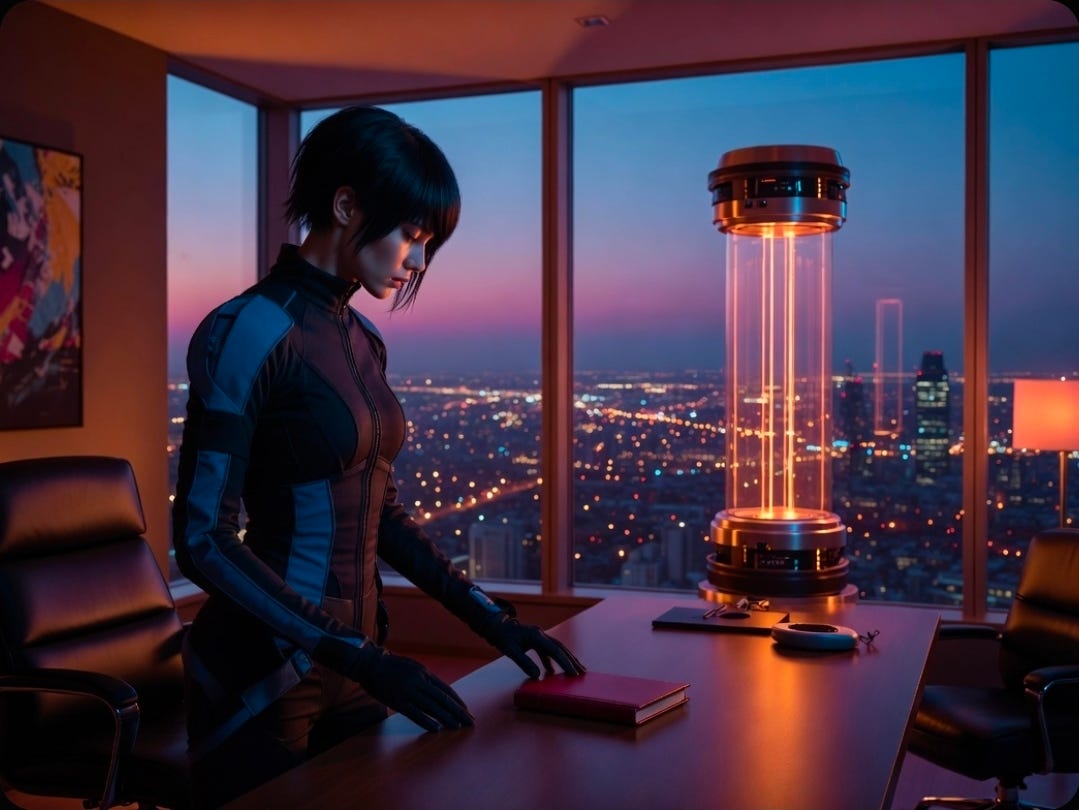
Mission Classification: High-Risk Extraction
This one is a longer level:
Buckle up!
Artifact Codename: THE RED BOOK
MISSION OVERVIEW
Objective: Infiltrate Archon Technologies corporate headquarters. Extract classified red book from CTO's penthouse office. Deliver to designated contact.
Team Composition: 5-6 operatives including courier protagonist. This is highly irregular. The courier typically works alone.
Opposition: Archon Technologies security (armed personnel, automated systems, psychic surveillance via VCI technology - Volitional Cognitive Interface readers throughout building). CTO has a reputation for handling security breaches personally when ego is sufficiently provoked.
Complications: VCI readers can detect surface-level thoughts and intentions. Standard infiltration will trigger immediate detection. Alternative approach required.
Courier Status: Uncomfortable with team operations. Prefers solo work. Will maintain professional cooperation but remains emotionally distant from team members.
PROLOGUE: THE UNUSUAL MEETING
The Descent
The courier receives coordinates via encrypted channel. A meeting. Multiple operatives. This almost never happens. The courier's work is solitary by design: no witnesses, no complications, no emotional entanglements.
This job requires a team though…
The courier will adapt.
The coordinates lead deep into the city's underground. Not the clean commercial underground with shops and transit stations. The real underground: access tunnels, abandoned infrastructure, spaces that exist in the margins of official maps.
The courier descends through a service entrance near the waterfront. Down rusted ladders, through concrete corridors thick with decades of grime and graffiti. The sound of the city above fades. The sound of the underground rises: distant water dripping, electrical hum, bass frequencies vibrating through walls.
The deeper the courier goes, the more the environment shifts. Graffiti becomes more elaborate, more intentional. Tags give way to murals, murals give way to installations. Light sources change from maintenance fixtures to deliberately placed neon.
This is the deep city. The place where people who don't exist in official databases live, work, and thrive.
The Club
The coordinates terminate at an unmarked door, heavy industrial steel with a small window at eye level. Bass thrums through the metal. The courier knocks: specific pattern, recognition signal.
The window slides open. Eyes assess. The door opens.
Inside: the club.
It's larger than the corridor suggested, carved out of some former industrial space. The ceiling is lost in darkness and catwalks. The walls are raw concrete, sweating with condensation. And everywhere, everywhere, fuchsia neon.
Neon strips run along the walls in chaotic patterns. Neon signs advertise things that don't exist. Neon sculptures hang from chains, rotating slowly, casting pink and magenta shadows across the crowd.
The darkness between the neon is absolute. The contrast creates disorientation: pupils can't adjust, constantly shifting between constriction and dilation. Everything feels unstable, dark and technologically ethereal. dreamlike.
The music is industrial, aggressive, all bass and distortion, with high melodic explorations woven in. It's more felt, vibrating through the floor, through the chest cavity, through the bones. Conversation is nearly impossible. Which is the point.
People fill the space: bodies moving to the rhythm, drinks in hand, faces obscured by shadow and neon. Some are augmented visibly (chrome prosthetics, facial modifications, implants of various kind). Some are augmented invisibly. Some are more baseline organic. In the deep city, no one asks.
The courier hates this environment. Too many variables. Too much chaos. And despite training and the audio augmenting ear implant model they're currently interfacing with, too loud to think clearly. But orders are orders.
The Meeting
A figure catches the courier's eye. Small gesture: this way.
The courier follows through the crowd, maintaining professional distance, eyes scanning for threats. The figure leads to a booth in the back corner, as far from the dance floor as possible but still bathed in fuchsia light.
Four people are already there. Five including the guide. Making six total with the courier.
The team.
A little rise of humor crosses the courier's mind with an internal chuckle.
They look like couriers: that specific quality of controlled danger, the awareness in the eyes, the way they hold their bodies ready to move. But they're looser than the courier, more comfortable in the chaos. They acknowledge the courier with nods, slight smiles, the casual confidence of professionals who've worked together before.
The courier sits last, positioning for optimal exit routes, back to the wall. Says nothing. Waits.
Team Member 1 (apparent leader): Tall, androgynous, sharp features, short platinum hair buzzed on the sides. Wearing tactical clothing disguised as street fashion. Moves with economical grace. Voice is calm, authoritative without being loud. Has to lean close to be heard over the music.
"Glad you could make it. I know this isn't your usual style." A slight smile acknowledging the courier's obvious discomfort.
The courier nods once. Professional acknowledgment, nothing more.
Team Member 2: Stocky build, darker skin, shaved head, facial scarring (burn marks, old). Heavy augmentation visible in the hands (reinforced knuckles, possibly integrated weapons). Sits with legs spread, taking up space, but not aggressive. Just comfortable. Gives the courier an appraising look, nods with what might be respect.
Team Member 3: Smaller frame, East Asian features, long dark hair pulled back tight. Wears glasses (unusual, possibly AR overlay tech disguised as vintage frames). Hands are constantly moving, subtle finger patterns that might be a nervous habit or might be interfacing with tech. Seems youngest, but eyes suggest otherwise.
Team Member 4: Medium height, athletic build, Mediterranean coloring, carefully maintained stubble. Dressed better than the others, like someone who usually operates in corporate environments. Leans back casual, but the courier notices the tension in the shoulders. Combat training.
Team Member 5 (the guide who led courier here): Tall and thin, very pale skin, possibly albino or heavily modified. Wears layered clothing despite the club's heat, open long coat over breathable -mesh underlayers. Face is serene, almost meditative. Moves like a dancer.
They're all professional. All capable. But they have camaraderie the courier doesn't share. Small jokes, knowing looks, the ease of people who trust each other.
The courier is ice in comparison. Robotic. Present but not participating.
The leader leans in, voice just loud enough: "The target is Archon Technologies. Corporate headquarters, downtown district. We need a book from the CTO's office. Small, red, traditional binding. Contents are above our clearance. We get it, we deliver it, we get paid."
The courier listens. Commits details to memory. Asks no questions.
"Problem is VCI scanners throughout the building," the leader continues. "Volitional Cognitive Interface. They read surface thoughts, detect hostile intent. We can't infiltrate clean. They'll pick us up the moment we think about the objective."
Team Member 2 speaks up, voice gravelly: "So we don't think about the objective. We get caught on purpose. Make the CTO want to deal with us personally. He's got an ego problem. Likes to handle breaches himself when they're interesting enough."
Team Member 3, fingers still moving in patterns: "VCI coverage everywhere except the penthouse. That's his private space. No surveillance, electronic or psychic. Black box room. We get there, we have freedom to operate."
The leader looks at the courier. "You comfortable with team operations?"
The courier's response is flat: "I'll adapt."
A brief silence. The team exchanges glances. They can read the subtext: the courier doesn't like this, doesn't trust group work, but will comply because the mission requires it.
The leader nods. "Fair enough. We move in three days. Meet at the staging point, coordinates incoming. Keep your head clear until then. VCI readers can't catch what you don't think about."
The meeting dissolves. Team members slip away into the crowd one by one, casual, no pattern. The courier waits until last, then exits.
The Long Way Home
The courier doesn't go directly back to the safe house. Standard protocol after meetings: assume surveillance, shake any tails, verify clean before returning to secure location.
The route home becomes a tour of the city: subway transfers, walking through crowded markets, ducking into shops and exiting through back doors, taking cabs three blocks and dismissing them, switching direction randomly.
Two hours to travel what should take twenty minutes. But when the courier finally approaches the safe house, there's certainty: no tail. No surveillance. Clean.
Inside, alone, the courier sits in darkness and processes.
Team operations. VCI readers. Getting captured intentionally. This mission has too many variables, too many points of failure, too much dependence on other people.
Bleh.
But the courier will do it anyway.
The ice doesn't crack. Not yet.
ACT TWO: THE INFILTRATION
Three Days Later: Staging Point
The team assembles in a rented space three blocks from Archon Technologies headquarters. Anonymous commercial building, office suite that's been vacant for months, no security cameras in the halls.
Inside: equipment laid out with professional precision. Tactical gear, communications devices, weapons (concealed carry types, nothing heavy). And something else: a medical case, biometric lock, contents unclear.
The team is already in mission mode. The casual camaraderie from the club is gone, replaced by focused professionalism. They move efficiently, checking gear, running system tests, confirming comm channels.
The courier arrives last, as always. Observes. Waits.
The leader opens the medical case. Inside: six syringes, each containing clear fluid. Neural suppressant, memory modification agent, something proprietary.
"Memory cap protocol," the leader explains, looking at each team member. "We can't go in thinking about the real mission. The VCI readers will catch it instantly. So we don't remember the real mission. We get temporary artificial memories instead, just enough to get us caught in the right way."
Team Member 4 frowns slightly. "What do we remember?"
"Surface level: we're industrial saboteurs hired by a competitor. Here to plant surveillance devices, steal financial data, standard corporate espionage. Nothing about the book. Nothing about the real objective. That's buried under the cap."
"And when does the cap dissolve?" Team Member 3 asks, fingers tapping that constant rhythm.
"Variable. Designed to degrade when the mission parameters are met. Could be minutes, could be hours. We won't know until it happens."
Team Member 2 holds up a syringe, examines it. "First time for everything."
The courier takes the syringe assigned to them. Studies it. The fluid catches the light, perfectly clear. Pharmaceutical grade, probably Zenith BioSystems manufacture. Ironic. Or is it?
"Everyone administers at the same time," the leader instructs. "We go in synchronized. Questions?"
The courier has no questions. Just looks at the syringe, then at the team.
Team Member 5, the pale one with the serene expression, speaks quietly: "Trust the process. Trust the plan. Trust each other."
The courier says nothing. Trust isn't the courier's strong suit.
"On three," the leader counts. "One. Two. Three."
Six syringes, six necks, six simultaneous injections. The fluid is cold going in, then warm, then hot. The courier's vision blurs. Thoughts scatter like startled birds.
The last clear thought before the memory cap takes hold:
~What sort of person am I becoming?~
Then the cap settles. New memories slide into place, artificial but convincing. The courier is here for corporate espionage. Simple. Clean. Nothing complicated.
Time to get caught.
Archon Technologies Headquarters
The building is a monument to corporate power: forty stories of glass and steel, occupying an entire city block. The architecture is aggressive, all sharp angles and reflective surfaces like some kind of crazy knife. It catches the sun and throws it back like a weapon.
The lobby is vast: its atrium with marble floors, security checkpoints, holographic directory displays. Armed guards at every entrance. Cameras everywhere. And somewhere in the infrastructure, the VCI scanners, invisible but present, reading the surface thoughts of everyone who enters.
The team enters separately, spacing their arrival over fifteen minutes. Different doors, different security lines. They're dressed as delivery personnel, maintenance workers, office temps. Forgettable. Unremarkable.
Except they're not. They're different kinds of professionals, infiltrating one of the most secure buildings in the city, and the VCI scanners are about to pick up exactly what the team wants them to pick up: we're here to plant bugs, steal data, commit corporate espionage.
Hostile intent, clear and obvious.
The alarms don't sound immediately. That's not how VCI detection works. Instead, security tracks them silently. Watches. Waits. Lets them get deeper into the building.
The courier makes it to the twelfth floor before the intercept happens.
The Capture
They come professionally: four security personnel in tactical gear, weapons drawn but not aimed. Firm voices, clear instructions. Hands visible. Don't resist. Come with us. Blah blah blah.
The courier could fight. Could probably take down two before the others respond. But that's not the mission. The memory cap says: we're here for espionage, we got caught, time to cut losses and run.
But running isn't an option. The building is locked down. Every exit sealed the moment the VCI scanners flagged the team.
The courier surrenders. Hands up. Compliant. Professional.
The security team relaxes slightly. This one isn't going to be trouble.
They're escorted to a holding area: windowless room, reinforced door, camera in the corner. The courier sits on the provided bench and waits.
One by one, the other team members arrive. Same room, same bench. They look at each other with resignation. Got caught. Mission failed. Standard operational risk.
They wait for what happens next.
The Invitation
Two hours pass. Then the door opens.
Not security this time. A man in an expensive suit, mid-forties, dark hair going grey at the temples. Confident smile. The energy of someone who knows he holds all the cards.
"Well," he says, voice smooth and amused. "In today's episode of clumsy industrial espionage.
Cute.
I was bored between meetings, that was fun. Did Helix Corp contract you? Or Meridian? I'm genuinely curious."
The team says nothing. Standard protocol: don't confirm, don't deny, don't engage.
The man's smile widens. "I'm Adrian Koss. Chief Technology Officer. And I have to say, I admire your gall. Getting caught this easily? Either you're incompetent, or this is intentional. And you don't look incompetent."
He walks around them slowly, assessing. "So let's say it's intentional. You wanted to get caught. You wanted to meet me. Well, here I am. Congratulations."
Team Member 1, the leader, meets his eyes. Says nothing.
"I could turn you over to law enforcement," Koss continues. "We know this kind of thing carries serious penalties. You'd be looking at ten years minimum, each. Or..." He pauses for effect. "Or we could strike up our own arrangement. You tell me who hired you, what you were actually after, and I'll consider being merciful."
Still silence.
Koss's smile doesn't fade, but something cold enters his eyes. "Alright. Let's try a different approach. Come with me. All of you. I want to show you something cool."
Security escorts them through the building. Up, always up. Executive elevator, key-card access, biometric confirmation. The numbers climb: 30th floor, 35th, 38th, 40th.
The top.
The Penthouse Office
The elevator doors open directly into the office. No hallway, no reception. Just straight into Adrian Koss's private domain.
The space is enormous. Floor-to-ceiling windows on three sides, offering panoramic views of the city. During the day, the light would be overwhelming. Now, evening approaching, the city is starting to glow. Millions of lights beginning to appear as darkness settles.
The office itself is minimalist: large desk (real wood, rare and expensive), a few chairs, abstract art on the walls. But the real statement is the view. Power looks down on everything.
Koss walks to the windows, hands behind his back, looking out over his domain. "Beautiful, isn't it? This city. All these people, all these lives, all of it flowing according to patterns they don't even see. But we see them. People like us."
The security team brings the couriers into the room, positions them in a line. The courier protagonist is separated slightly, positioned closest to Koss.
The courier's eyes move, professional assessment: exits (just the elevator), surveillance (none visible, unusual for a corporate executive), blind spots (several, the room is too large and the security personnel too few).
Then the courier sees it.
On the desk. Small. Red. Traditional binding.
The book.
The courier doesn't react outwardly. Doesn't let recognition show. But something shifts in the courier's awareness. Important. That book is important. Why is it important?
The memory cap holds. The courier doesn't consciously remember the real mission. Just feels vague significance.
Koss is still talking, back turned to the room, monologuing about corporate philosophy and the nature of power. Classic villain behavior, so in love with his own voice that he doesn't maintain tactical awareness.
The courier takes one step closer to the desk. Then another. Casual. Unthreatening.
The book is right there.
Koss turns slightly, still talking, gesturing at the city. "The thing about power is that it requires demonstration. People need to see what happens when they challenge it. Otherwise, what's the point?"
The courier's hand moves. Smooth. Practiced. Picks up the red book, slides it into an inner pocket. The motion is so natural, so integrated with shifting weight, that it's nearly invisible.
Team Member 3 sees it happen. Eyes widen fractionally. Doesn't react otherwise.
Koss is still talking: "Which brings me to why I brought you up here. I want to show you something we've been developing. New technology. Quite revolutionary, really."
He walks to the corner of the room. The courier hadn't noticed it before: a device, approximately two meters tall, its body a simple cylinder on its side with legs.. nothing particularly revolutionary looking. But the materials seem to hum with power, a strange frequency that's felt. There's a faint shifting light emitted from the surface of the metal on the side facing them.
Koss looks at it with pride. "This is a Planck-Scale Resonance Disruptor. Operates at the smallest possible measurement of reality itself.
Do you understand what that means?"
The team says nothing.
"It means," Koss continues, clearly enjoying the explanation in a tacky fashion, "that it tears matter down to quantum probability. You stop being solid. You become potential. A cloud of maybe." He smiles.
"I've been testing it on drugged rats all week. Every single one scattered into atomic mist, not even pink. The process is beautiful. Irreversible."
The courier's blood goes cold. A weapon. A death machine. With metaphysical implications about the fabric of reality. This technology would spend the world as they knew it. Well beyond normal historical scopes of corporate and state warfare.
"So here's what's going to happen," Koss says, his voice losing its conversational tone, becoming harder. "You're going to tell me who hired you and what you were really after. Or I'm going to start throwing you into that device one by one. And unlike the rats, you'll be conscious for the whole process. You'll feel yourself coming apart. Atom by atom."
The security team tenses. Weapons come up slightly.
Team Member 1 speaks for the first time: "You're fucking insane."
Koss shrugs. "Maybe. But I'm insane with a molecular disintegrator in my private office, and you're interlopers who just disappeared into the building with no trail. Who's really in the better position here?"
He starts walking toward the courier. "Let's start with you. You look like the quiet type. Quiet types always break the most interestingly."
The courier's mind is moving fast. The book is in the pocket. The device is in the corner. Koss is approaching. Security is armed. The team is outnumbered.
And underneath all the tactical calculation, something else is speaking.
Wordless. Absolute. It isn't reasoning or logic or training.
//Run. Jump. Now.//
The courier doesn't understand why. Can't explain it, but doesn't question it.
Just moves.
ACT THREE: THE DIVE
The Decision Point
Koss reaches for the courier. His hand is inches away.
The courier's body reacts before conscious thought completes. Years of training, instinct honed to reflex, all of it coalescing into motion.
The courier spins away from Koss's reaching hand. The body lowers the center of gravity to launch with explosive thigh power towards an escape.
Pulls the red book from the pocket (securing the objective, even if the courier doesn't consciously know why it matters). Runs.
Not toward the elevator. Not toward the windows.
Toward the device. The Planck-Scale Resonance Disruptor. The thing that turns matter into atomic mist. The guaranteed death machine.
"For fucks sake, stop them!" Koss shouts.
Security personnel move, but they're too slow. They genuinely didn't expect this. Didn't expect anyone to run toward the disruptor. Madness. Why would anyone run toward certain death? They were stunned for just a second long enough to get the jump on them.
The courier is fast. Faster than they look. Crosses the office in seconds, the red book clutched tight.
The device is right there. Up close, it's even more wrong: the surface seems to shift and distort the closer you get… warping.. reality bending around it like heat shimmer. The hum is deeper here, resonating in the chest cavity, in the teeth. It feels like standing next to an abyss that's looking back.
Every rational thought screams: STOP. That's death. Pure, absolute, molecular dissolution. There is no survival. There is only becoming atomic mist.
But the voice underneath the rational mind is louder. Certain. Absolute.
//Jump.//
The courier doesn't hesitate. Doesn't slow. Just commits fully to the action.
Dives headfirst at top speed into the Planck-Scale Resonance Disruptor.
And instead of an atomic mist, a flash is emitted, and the courier is gone.
The Sensation
Reality comes apart.
The word pain is too small for what happens. Every atom in the courier's body begins to vibrate at frequencies that shouldn't be possible. Molecular bonds stretch, strain, begin to separate.
The sensation of falling, but in every direction at once. Up is down is sideways is inside out.
Color becomes sound becomes texture becomes taste, taste become tactile. Synesthesia elevated to cosmic scale. The courier can hear the color infrared, can taste gravity fluctuating, can see time spreading out like an aurora oil slick on water in slowmo and all at once.
Quantum decoherence. The courier is becoming probability. Becoming potential. Becoming maybe.
But.
Something else is happening.
Deep in the courier's cellular structure, something is responding. Some frequency encoded at a fundamental level. Some resonance that matched the device's output when running at speed. A kind of matching of toroidal energy..
The courier's quantum signature aligns with the “disruptor's” frequency.
It was never meant to be applied as the destructive force at all. Its a transport technology.
Instead of scattering into atomic mist, instead of becoming a cloud of probability that collapses into nothing, the courier becomes something else:
Coherent. Directed. Tunneling.
The disruptor isn't destroying the courier. It's opening a door.
The Wormhole
The sensation shifts. The vibrating-apart-into-probability feeling gives way to something else: motion. Momentum. Being pulled or pushed or both through something that is more than pedestrian ideas of spacetime.
Wormhole is the best word, though it feels inadequate; but definitely a tunnel through dimensions, through probability states, through the spaces between spaces.
Time becomes meaningless. It could be seconds or hours or years. No way to measure, no reference point.
Then: light. Exit.
The courier comes out the other side.
ACT FOUR: THE HOMETOWN
Arrival
The courier lands hard on concrete.
Momentum hitting the ground in a roll that luckily training makes automatic. The red book is still clutched, somehow intact through the impossible journey.
The courier stands, breathing hard, adrenaline screaming through the system. Looks around.
The first thing: sunlight. Bright, warm, natural. After the office's artificial lighting and the wormhole's impossible colors, the ordinary sun feels shocking.
The second thing: the sounds are wrong. No city ambient. No traffic roar, no construction, no crowds. Just quiet. Small-town quiet. Birds. A dog barking in the distance.
The third thing: recognition.
The courier knows this place.
The street is quaint, tree-lined, modest suburban mid century architecture. The pavement is old-style asphalt, slightly cracked, patched in places. The courier's eyes track left, right, cataloging details that feel familiar in a way that bypasses conscious memory.
There: the corner where the street intersects with the main road. The courier knows that corner… Has been there and has stood waiting for something, the memory won't surface clearly, but the recognition is undeniable.
There straight ahead: the town's main street. The courier can see it from here, two blocks away. Small shops, local businesses, the architecture of small-town America in the 1990s.
The 1990s?
The courier looks around with new awareness. The cars parked on the street: old models, boxy and simple, none of the sleek designs of current era. The clothing visible on people: styles from decades past.
So this isn't just a different dimension. It's a different time.
The courier has traveled backward.
The courier starts walking, moving toward the main street. The mind is trying to process: traveled through a dimensional disruptor, survived what should have been certain death, ended up in the past, in a hometown the courier shouldn't remember but seemingly does.
Nothing about this makes tactical sense. Nothing follows operational logic.
But underneath the confusion, that wordless certainty remains. This is where the courier is supposed to be.
Main Street
The town's commercial district is exactly as the courier remembers: a single main street, maybe six blocks long, lined with local businesses. Hardware store, pharmacy, diner, insurance office, bank, grocery store.
And there: the hamburger joint.
The courier stops walking. A few lingering Stares.
How out of place must I look, should get off the main drag til better oriented.
The sign says "Squidly's Burgers" in teal and pink letters, slightly faded. The building is small, 1980s aesthetic maintained through the decades. The courier can see through the windows: silver vinyl booths, chrome-trimmed counters.
The courier has been there. Many times. Can remember (almost, the memory is slippery) sitting in one of those booths, small legs not reaching the floor, a chocolate milkshake in front, someone across the table smiling, saying something that made the courier laugh.
The courier shakes off the nostalgia. Focus. Need to understand the situation. The book is still in hand, solid and real. The team is back in the present, presumably. The mission is compromised. The courier is alone in the past with no extraction plan.
And then the courier sees it.
The Shop
Two doors down from Squidly's Burgers, a small storefront is in the process of renovation. The windows are covered with brown paper. The door is propped open. Inside, visible through the doorway: mostly empty space, drop cloths, paint cans, the chaos of construction in progress.
And a person working inside. Moving around, organizing, preparing to open some kind of business.
The courier approaches slowly. Something about this feels significant, though the courier can't identify why. Just that wordless certainty again: this matters.
The courier reaches the open door, looks inside.
The space is small: one large room with a back office visible through a doorway. The walls are freshly painted, neutral beige. The floor is being refinished, half covered with drop cloths. A few boxes of supplies are stacked in the corner.
The person working is a man in his forties, wearing casual clothes and work gloves. He's unpacking boxes as he hums to himself, clearly in good spirits about the new business venture.
He looks up when he notices the courier in the doorway. Smiles. His demeanor is friendly, open, the way people in small towns often are with strangers.
"Hi there," he says. "Can I help you? We're not open yet, obviously, but if you need something I can try to point you in the right direction."
The courier should be calculating: who is this person, what's their connection to the mission, why does this location matter. But instead, the courier just stands there, holding the red book, covered in street dust from the dimensional transit, probably looking mildly unhinged.
"I..." The courier's voice sounds strange. Too many unusual things happening in too short a time. "What kind of business are you opening?"
The man's smile widens. "Bookstore. Independent, mostly used books, some new. Fill a niche, you know? The town doesn't have one, and I always thought it should. Love books. Love this town. Seemed like the right combination."
A bookstore. The courier is holding a book.
"That's wonderful," the courier says, and means it. The response is automatic, coming from somewhere beneath the professional surface.
“someone opening a bookstore in a small town is always a good thing.”
A hopeful thing.
The man gestures to a folding chair near the window. "Want to sit down? You look like you've had a day. I was about to take a break anyway. Got some cold water in the cooler."
The courier should decline. Should maintain operational security. Should figure out what's happening and develop an extraction strategy.
But instead, the courier says: "Thank you. That would be nice."
ACT FIVE: THE REALIZATION
The Conversation
The shopkeeper retrieves two bottles of water from a cooler in the back office. Hands one to the courier. Takes the other folding chair for himself. They sit in the mostly empty shop, sunlight streaming through the open door.
"Beautiful day," the shopkeeper says, twisting open his water bottle. "Been working on this place for two weeks now. Hoping to open in a month. Just need to get the shelves installed, stock some inventory, do the official paperwork."
The courier nods, drinks water, feels the absurdity of the situation: sitting in a bookstore in the 1990s, having normal conversation, while holding a stolen book after traveling through a dimensional disruptor.
"You from around here?" the shopkeeper asks, making small talk with the ease of someone who genuinely enjoys talking to people.
"I was," the courier says. The truth, or part of it. "Long time ago."
"Moved away?"
"Yes."
"Come back to visit?"
"Yea, something like that, just passing through for the memories.”
The shopkeeper accepts this vague answer without pushing. "It's still good town. Quiet. Safe. Good place to raise kids if that's your situation. Good place to retire if it isn't. Just... good."
The courier looks out the open door at the main street. At Squidly's Burgers. At the familiar storefronts and the unfamiliar cars and the sunshine that feels like childhood.
"Yea, it still feels good," the courier agrees quietly.
They sit in comfortable silence for a moment. The shopkeeper drinks his water, looking around his future bookstore with satisfaction. The courier holds the red book, still processing the impossibility of the last thirty minutes.
Then the courier notices: coat. The courier is still wearing the tactical coat from the mission. It's covered in dust, slightly torn from the dimensional transit, definitely out of place in this small town in this decade.
The courier stands, feeling suddenly overheated and uncomfortable. "Do you mind if I take off my coat?"
"Of course not," the shopkeeper says. "Make yourself comfortable."
The courier removes the coat, drapes it over the chair. The red book is still in hand. The courier sets it on the coat, carefully, without thinking about it.
Relief. The coat was heavy, constraining. The air in the shop is warm but pleasant.
They talk for a few more minutes. About nothing important: the weather, the towns growth, what kind of books the shopkeeper plans to stock. The courier participates minimally, giving brief responses, but there's something calming about the mundanity of it. After the chaos of the mission, the disruptor, the dimensional travel, just sitting and talking about books feels surreal in its normalcy.
Then: movement outside.
The courier's training snaps back online. Eyes to the window. Assessing.
Five people running past the shop. Moving fast. Familiar silhouettes.
The team.
The Snap
Recognition hits like physical impact.
That's the team! The courier's team. From the mission… From the office. From the “present”.
They came through the disruptor. They saw what the courier did. They followed.
Which means this is real. This is actually happening. The dimensional travel, the time displacement, all of it is real.
The courier stands abruptly. "I have to go. I'm sorry. Thank you for the water."
The shopkeeper looks surprised but not offended. "Oh, sure. No problem. Hope you enjoy your visit to town, come back and see us when we’re up and running properly."
The courier moves toward the door, fast, the team is already past, need to catch up, need to regroup.
Out the door. Into the sunshine. Looking left, right, spotting the team half a block away, moving together, clearly looking for something.
Looking for the courier.
The courier starts to run. "Wait!"
The team turns. Sees the courier. Relief visible on their faces. They slow their gait but keep moving.
The courier runs toward them, boots slapping pavement, breathing hard from adrenaline and confusion and the sheer impossibility of everything.
Reaches the team. Team Member 1 grabs the courier's shoulder as they slow slightly more. . "You okay? What the hell was that? What happened?"
"I don't know," the courier says. "The device, I jumped, and then I was here, and, "
Team Member 3 interrupts: "We followed you. Saw you dive in, thought you were dead, but then we followed you.. All of us."
They're all here. All six. In the courier's hometown. In the 1990s.
"We need to figure out where we are," Team Member 2 says, scanning the street with professional wariness. "When we are. How to get back."
"Agreed," the leader says. "But first, did you get the book?"
The book.
The red book.
The courier's hand goes to the pocket. Empty.
Horror floods through. The book. Where's the book?
The courier spins, looking back at the shop. Remembering: taking off the coat. Setting the book on the coat.
Leaving it there.
"I have to go back," the courier says, turning.
But the memory cap is starting to dissolve.
It happens suddenly, without warning. The artificial memories peel away like old paint, revealing what was underneath.
The real mission floods back.
Not corporate espionage. Not getting caught and brought to Koss's office and stealing the book in a moment of opportunity.
The planned mission: Get caught on purpose. Get brought to Koss's office. Grab the book when his back is turned. Jump into the disruptor (exit route, dimensional travel, programmed resonance frequency). Land in the past. Deliver the book to the agent in the hometown.
The agent.
The shopkeeper.
A “friendly” man opening a bookstore.
He's not just a shopkeeper.
He's the contact.
The delivery point.
The whole reason for the dimensional travel.
The jacket delivery method. Take off coat. Leave book in coat. Casual interaction. The shopkeeper retrieves the book after the courier leaves. Mission complete.
Which the courier just did. Accidentally. While memory-capped and not consciously knowing the plan.
Perfect execution through unconscious action.
The courier starts laughing. Can't help it. The absurdity is too much. Traveled through a dimensional disruptor, survived molecular disintegration, time-traveled to childhood hometown, delivered classified book to undercover agent while making small talk about the weather.
All according to plan.
The team is staring at the courier like they're experiencing a breakdown.
"I delivered it," the courier says, still laughing slightly, the sound edged with hysteria. "I just delivered the book. To the agent. The shopkeeper. That was the mission. We did it."
The memory cap dissolves for them too. The courier can see it happening: eyes widening, expressions shifting from confusion to understanding.
Team Member 4 says what they're all thinking: "So we're stuck here."
"Yes," the courier confirms.
Silence. The six of them standing on a small-town main street in the 1990s, with no way home, the mission complete and the extraction plan nonexistent.
"Fuck," Team Member 2 says with feeling.
The courier looks back at the bookshop. The shopkeeper is probably discovering the book right now. Opening the coat, finding the red book, understanding that the delivery was made.
He won't come after them. Won't try to return it. That would compromise the operation. He'll just take the book, secure it, and continue opening his bookstore like nothing happened.
Perfect operational security.
Terrible situation for the couriers.
"We need to figure out how to get back," the leader says, taking command. "The disruptor was one-way. We don't have the tech to create a return portal. But there has to be a way."
The team looks at the courier.
The courier glances back one more time at the bookshop.
Somewhere in there, a man who seems kind and ordinary is holding a red book that contains information important enough to require dimensional travel for delivery. Information that had to be moved through time itself to reach the right hands.
The courier doesn't know what's in the book. Above clearance. Need-to-know.
But the courier knows this: whatever it is, it mattered enough to strand six people in the past.
That has to mean something.
The courier turns away from the bookshop, follows the team who's begun to keep moving without the courier's reply, and doesn't look back again.
AFTERMATH: STRANDED
The New Reality
The team finds an abandoned building on the outskirts of town: old warehouse, no longer in use, structurally sound enough for temporary shelter. They break in through a side door, secure the space, and settle in to plan.
Night falls. The town goes quiet. Through the warehouse windows, they can see stars. More stars than the present-day city ever showed, the sky less polluted with light.
They sit in a circle, using emergency glow-sticks for light, and face the truth: they're stuck here. No extraction plan. No backup. No way home that doesn't involve infiltrating a military installation in an era where their faces aren't in any database and their skills are decades ahead of current spec.
"We could try to blend in," Team Member 3 suggests. "Get jobs. Live normal lives. Wait until the present day catches up."
"That's thirty years," Team Member 2 points out. "I'm not waiting thirty years."
The memory cap is fully dissolved now. The real mission is clear: deliver the book through time. Check. Complete.
But the memories that are surfacing aren't just about the mission. They're deeper. Older.
Maybe the memory cap dissolved more than the missions neural nets configurations.
The courier remembers this town. Remembers being young here. Remembers the hamburger joint, the swing in the yard, the corner where the courier waited for... something. Someone.
They were preparing the courier for this. For the mission that just happened.
Long-term planning. Decades of planning. Creating tools for missions that wouldn't happen for years.
The courier was never just a courier. The courier was always an experiment..
And now, having fulfilled that purpose, the courier is disposable. Stranded in the past. No longer useful. The realization should hurt. Should trigger anger, grief, something.
But the courier just feels numb.
"We rest tonight," the leader is saying. "Tomorrow we scout what we're dealing with. Then we plan."
The team agrees. They settle into sleeping positions, using their coats as pillows, weapons within easy reach.
The courier lies awake, staring at the warehouse ceiling, thinking about the shopkeeper who runs a bookstore and holds a red book whose contents the courier will never know.
Thinking about Astrid, who died because her father tried to do the right thing.
Thinking about Véronique Millais, who makes beautiful dangerous things and now questions whether she should.
Thinking about the angel with the Sri Yantra on his chest who said "the matriarchy is dead."
Thinking about all the pieces that don't fit together but feel connected anyway.
What sort of person are you?
The courier still doesn't know. But the courier is starting to understand that the answer matters more than the mission ever did.
Outside, the stars wheel slowly across the sky. The same stars that shine in the future. Different view, same light.
The courier closes eyes and tries to sleep.
Tomorrow: who knows, maybe infiltrate a military base. Find the tech. Try to go home.
But underneath that practical objective, a deeper question:
If the courier makes it back to the present, what then? Return to being a weapon? A tool? An experiment?
Or choose to become something else?
For the first time, the courier is asking the question.